Nexus AI - AI Document Intelligence Platform
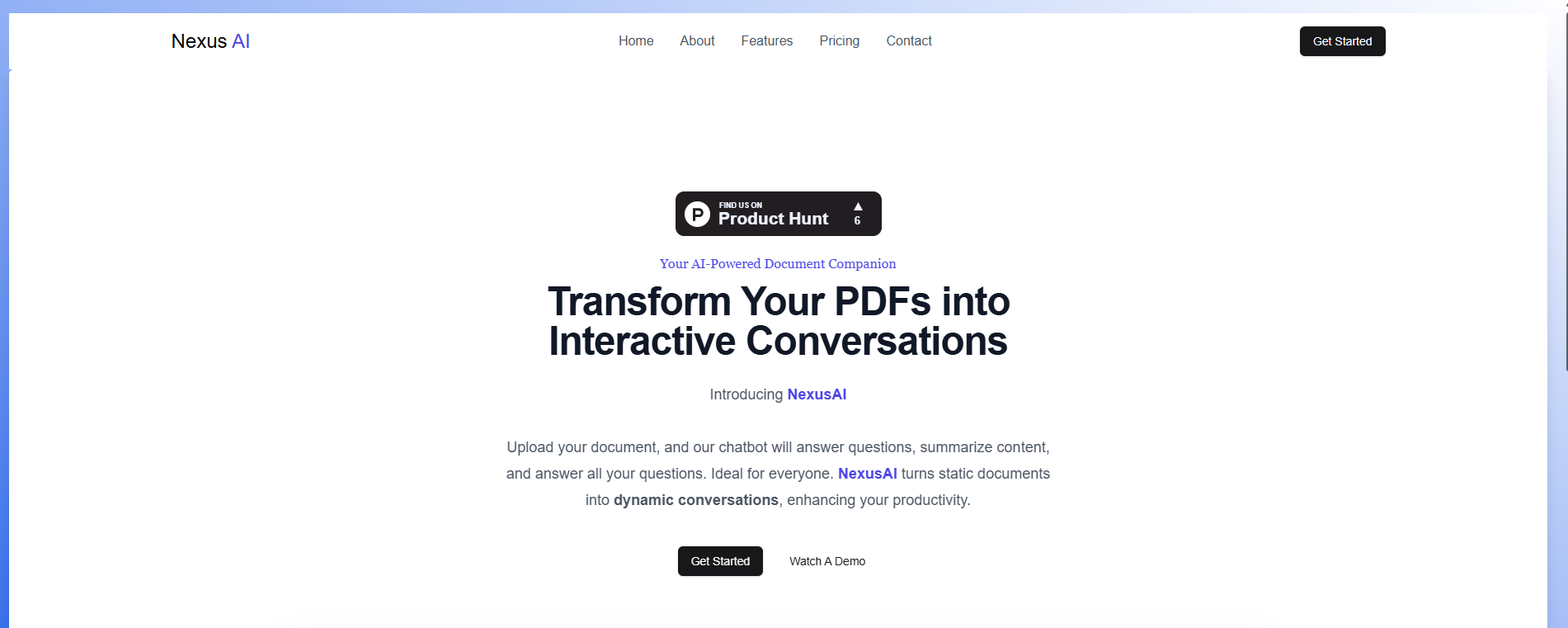
Nexus AI lets you chat with your PDFs. Upload a document, ask questions, get answers grounded in the file, with citations back to the page. Documents stay encrypted in storage, and the model only sees what you ask about. Built for people who'd rather skim a conversation than scroll a 60-page report.
The Story
- • Early 2023: I had mountains of study notes in PDFs but ChatGPT (GPT-3.5) couldn't ingest documents. You could only paste text, and context windows were tiny.
- • Asked my friend Shadrack: 'How do you even use AI to study if it can't read your notes and give relevant answers?' He had no solution either.
- • That question stuck with me. If AI couldn't understand my documents, it was useless for the one thing I needed: studying efficiently.
- • Discovered vector embeddings and RAG architecture. Built v1 using OpenAI's API. Costs hit $400/month and I bailed.
- • Switched to Groq's inference and Pinecone's vector search. Dropped costs to about $20/month while keeping accuracy.
- • Hybrid search (dense vectors with sparse keyword matching) eliminated hallucinations. Users trust precise answers, not confident guesses.
- • Nexus AI ended up as something I could use myself: study notes I could ask questions of, with citations back to the page.
Video Demo
Key Features
- Running 500+ documents per month with responses in under 1.5 seconds. Fast enough that users don't hesitate on follow-up questions.
- Document discovery in 8 seconds instead of 30+ when searching traditional PDFs. About 75% faster, and the savings compound with use.
- Paystack handles subscriptions with a 98.5% payment success rate, so we're not chasing refunds or losing revenue to failed transactions.
- Dropped infrastructure costs from $400/month to about $20/month with the Groq + Pinecone setup.
Challenges & Solutions
The Challenge
The hard part wasn't the RAG architecture; it was hallucinations. When you're querying documents, users expect precision. I implemented a hybrid search algorithm combining dense vector embeddings with sparse keyword matching, then re-ranked results to eliminate noise. The system needed to understand both semantic meaning and exact phrase matching simultaneously, which sounds simple until you realize context windows are limited and every millisecond counts.
What I Learned
- • Pure semantic search misses exact phrases. Hybrid search with keyword matching is what works.
- • LLM API costs will destroy your margins unless you optimize hard. Groq with Pinecone was what made this sustainable.
- • Anything under 2 seconds feels instant. Past 3 and users start thinking the system is broken.
- • Billing is harder than it looks. Refunds, failed transactions, chargebacks: you need robust error handling or you lose money.
- • My assumptions about user behavior are usually wrong. Early feedback kept mentioning 'Can I use this on mobile?' I didn't think mobile mattered for document analysis. Made it fully responsive. Sign-ups picked up immediately. Ship what users ask for, not what you think they need.
Impact & Growth
- • Validated that people pay for document search that works.
- • Cost optimization became the durable advantage. Most competitors get crushed by API bills; we stayed profitable.
- • Built a reusable RAG pipeline that's now the foundation for every AI project I touch.
- • Got the MVP-and-iterate loop down. Started bare-bones, listened to users, kept only what mattered.